Our class recently took a field trip to an aquarium to see some of the animals that we studied earlier in the year. Since the aquarium was big and considerably far away and we had to be back at school in time for the buses, we didn't get much time to see the animals. However, I am only going to mention two examples that related most to my science curriculum. We got a chance to see hippos and birds. The two hippos seemed to be asleep, and the birds would occasionally land on their heads. After further investigation, I found out that the birds land on the hippopotamus' heads to pick off toxins that are potentially harmful to the hippos. This is a great example of symbiosis, where at least one animal benefits from another animal. In this case, both animals benefit- the bird gets food, and the hippo gets toxins picked off of it.
Another animal that we saw was the medusa jellyfish. It comes from the phylum of "Cnidaria", which means "stinging cells". I'm sure you know that jellyfish sting, but do you know how they sting? Since they don't have eyes, they use the sense of touch rather than sight to find their prey. When something brushes up against them, a cell shoots out of its skin and acts almost like a harpoon. This then injects venom into whatever brushed up against it. The venom is only deadly enough to kill small animals that can be eaten by the jellyfish and are generally uncomfortable but harmless to humans. This is the stinging sensation that you feel, hence the name "stinging cells".
I enjoyed the aquarium field trip. There were quite a few things that I could relate to experiences in my science class this year, and aquariums in general are just fun. I would have liked to have a bit longer to stay at the aquarium, however. I would like to go back with family or friends one day and stay a while longer to see the rest of the animals. Overall, the aquarium was a fun time.
Tuesday, May 18, 2010

Tuesday, March 23, 2010
Chilean Earthquake
Early in the morning on February 27, 2010, a massive and devastating earthquake hit Chile. An 8.8 on the seismograph, it is said to be the strongest since 1960, when an earthquake sent a tsunami across the Indian Ocean. Some areas, such as Santiago, are on the fault lines, so tremors are not unusual. This, however, was far from normal. 706 people are reportedly dead, 500,000 homes destroyed, and 1.5 million people were affected. About ninety aftershocks have rattled Chile again, one being almost as strong as Haiti's devastating tremor. People in Chile have lost power, water, internet, not to mention homes... so many luxuries that we, as Americans, take for granted.
In my opinion, Chilean citizens are doing a great job maintaining positive attitudes and working to get everything back to normal. It's these attitudes that get things done. At the same time, I feel sympathy for Chile. I mean, you wake up one morning to an earthquake destroying the country. What are you supposed to do? Chile's situation is heartbreaking, but they're strong, and I'm confident that they'll get through this.
Source: http://www.cbc.ca/canada/saskatchewan/story/2010/02/28/sask-chile-earthquake-reax.html
In my opinion, Chilean citizens are doing a great job maintaining positive attitudes and working to get everything back to normal. It's these attitudes that get things done. At the same time, I feel sympathy for Chile. I mean, you wake up one morning to an earthquake destroying the country. What are you supposed to do? Chile's situation is heartbreaking, but they're strong, and I'm confident that they'll get through this.
Source: http://www.cbc.ca/canada/saskatchewan/story/2010/02/28/sask-chile-earthquake-reax.html
Wednesday, January 27, 2010
Math Blog- How is Global Warming Related to Math?
As I'm sure you've heard, the Earth's surface temperature is increasing because of anthropogenic (human-caused) pollution. That's the topic of a research essay that I wrote, so I know a lot about this phenomena. The essay covered four out of five subjects: Science, in the aspect of how the Earth is warming, Social Studies, represented in how people are affected and/or causing global warming, Literature, in researching and comprehending information, and Language Arts, in writing the actual essay. The only subject left out is Math, and my assignment is to relate global warming to mathematics. Well, scientists use math to predict the rates at which some factors may escalate. If math weren't involved, scientists wouldn't be able to predict how warm it may get, when it can get that warm, and the extinction rates of animals and plants. Math is also needed to find the rates at which the temperature has already changed, and the speed that it is increasing at. If you think about it, this is most of the information that we need to understand global warming. So if we didn't have math, global warming would pretty much be a mystery. Thank you, mathematics, for helping us understand why the Earth is warming, and why it's such a big deal!
Thursday, January 14, 2010
Haitian Earthquake-- Why So Significant?
The story of the massive earthquake in Haiti on January 12, 2010 has been all over the news. But what makes this earthquake more significant than other earthquakes that have occured recently? Well, there are three good reasons:
- The earthquake occured extremely close to Haiti's capital city, Port au Prince.
- It occured only 10 or 15 meters below the Earth's crust, which is very shallow, and makes the earthquake notably powerful.
- Haiti is a poor counrty, and many people can't afford to build a strong building. As a result, many buildings were destroyed.
These factors coming into play made this earthquake a "worst case scenario," as Jian Lin, a senior scientist with Woods Hole Oceanographic Institution (WHOI) said. The Haitian earthquake was caused by "a highly complex tangle of tectonic faults" underneath where the North American tectonic plate meets the Carribean tectonic plate. The strike-slip fault didn't cause a tsunami or any other type of dangerous or disconcerting wave because it was underneath land, as opposed to sea. Aftershocks are expected from any amount of time from days to decades. Unfortunately, about 50,000 people were killed. All of the other Carribean nations are advised to take note and stay alert- this could be their fate as well.
While I extend my deepest sympathy to Haitians affected by this massive tremor, I am glad that it didn't claim more than the 50,000 lives that have already been lost because of it. I can't imagine something this devastating taking place in my hometown, and I'd prefer not to. The terrible fact that this devastation took place anywhere in the world is upsetting. I anticipate and hope that Haiti will be able to rebuild, just as New Orleans, Louisiana did after Hurricane Katrina wiped out homes and buildings in August 2005.
Source: ScienceDaily
http://www.sciencedaily.com/releases/2010/01/100114143321.htm
Monday, November 23, 2009
Class Response- Cork Popping Experiment

*Note: This picture shows the reaction between baking soda and vinegar in an uncorked test tube. In our experiment, the test tube was corked.
As you can imagine, class was quite interesting when our teacher announced that our experiment was to shoot a cork across the classroom. The method was actually quite simple- we had to find the correct ratio of baking soda to vinegar to make the cork hit the window on the other side of the classroom, which was 675 cm away. The combination of baking soda and vinegar causes a chemical reaction, creating carbon dioxide, or CO2. The CO2 then expands, creating pressure behind the cork. This is what causes the cork to pop out of the test tube.
- In our first attempt, we used 10 mL of baking soda, and 15 mL of vinegar. We first added the baking soda to the test tube. Once we were on the firing range, we added the vinegar. The cork went 605 cm out of the total 675 cm.
- My lab partners and I decided to increase the quantities of both the baking soda and vinegar for our second attempt. When we were on the firing range, the test tube was pointed too low. As a result, the vinegar spilled directly onto the floor, only a little bit getting into the test tube. The cork only popped 40 cm.
- Since we made a silly mistake on our second attempt, we decided to try the same thing again. This time, our cork popped 655 cm out of the total 675 cm.
- We decided to increase the amount of baking soda to 20 mL, and decrease the amount of vinegar to 10 mL. This time, the cork popped 589 cm, 156 cm less than the time before.
- This time, we decided to add the vinegar first, as in our tries 1-4 we had added baking soda first. When the baking soda was added, there was not much initial reaction. Because of this, my lab partner, who was holding the test tube, shook it. Unfortunately, he shook it vertically. The cork shot up, hit the ceiling, and fell behind us.
- We decided to try the same method as Trial 5. The cork went 401 cm before falling down. My lab partners and I agreed that adding baking soda first doesn't work as well.
- For our 7th try, we decided to use equal amounts of baking soda and vinegar, using 15 mL of both. We also went back to adding the baking soda before the vinegar. This proved to be our best method so far- it went the full 675 cm, hitting the vent at the back of the class. However, we did not hit the window.
- We decided to use the same method again, but aim more toward the window. The cork went 675 cm again, hitting the windowsill, but again, not the window.
- Our group decided to increase both the quantities of baking soda and vinegar to 20 mL. This time, the cork hit the last tile, so again, it went 675 cm.
- Once again, we tried the same thing, and got the same result. We kept getting so close to hitting the window, but that's all we got- close.
- For our 11th attempt, we used 10 mL of baking soda, and 20 mL of vinegar. This time, the cork popped out, hit the light, and fell, at 510 cm.
- We used the same method as above, and got the result that we had been getting-the cork went 675 cm, and hit the vent at the back of the class.
- Our 13th try was our last. We decided to try the same thing as our 12th try, hoping that our problem was with our angle. We tried it again, and got the same result.
Overall, I thoroughly enjoyed this experiment. Though our group's cork never hit the window, we had fun trying to figure out how to get the result we want. I think that out of all the experiments we've done so far, this was my favorite.
Wednesday, October 21, 2009
Meteor Shower- October 2009
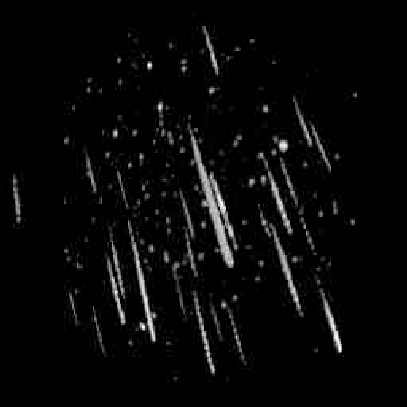
Just for the record, the image above is not of the Orionids Meteor Shower, it is a picture of the Perseids Meteor Shower. I could not find a clear picture of the Orionids Meteor Shower, and this is why I am using the Perseids Meteor Shower to substitute.
As you may know, the Orionids Meteor Shower was visible in our sky starting on October 2. This meteor shower occurs every October. Halley's Comet, which causes the Orionids Meteor Shower, also produces another meteor shower in May called Eta Aquarids.
Before I go into any more detail about the Orionids Meteor Shower specifically, I should probably give a little bit of information about meteor showers themselves. A meteor is a streak of light in the sky. They occur when a meteoroid, which is a solid moving object in space and often come from a comet (as in the case of the Orionids) , enters the atmosphere. These, when they are in clusters, are called meteor showers.
The Orionids Meteor Shower gets its name, like many other meteor showers, from a constellation it seems to radiate from. In this case, this constellation is Orion. This meteor shower will be visible from October 2 until November 7. The strongest activity supposedly took place this morning, October 21, during the predawn hours. The Orionids always seems to show what is called "submaxima activity" from October 18 until October 24. This means that sudden outbursts may occur at any time. Like I said before, the Orionids Meteor Shower is only in the sky until November 7, so if you are interested, look up and towards the constellation Orion while it is dark outside, and see what you can see!
Sources:
MeteorBlog.com: www.meteorblog.com
Wikipedia.com: en.wikipedia.org/wiki/Meteor#Meteor
Friday, September 18, 2009
Blue Eyes
Scientists have known for a while that blue eyes were caused by a genetic mutation about 10,000 years ago. Just recently, they found the mutated gene, called the OCA2 gene. This gene, located in the chromosomes, controls melanin production in the iris, which gives your eyes their color. Brown eyes contain a lot of melanin, while blue eyes contain little. Depending on the amout of melanin, eyes can be any color from brown to green. Originally, all people had brown eyes. Scientists say that all blye-eyed people have exactly the same DNA sequence, linking them all to one common ancestor. All blue-eyed people inherited the genetic switch in the same spot of DNA. The genetic switch somehow spread throughout Europe, and now other parts of the world.
I found this article interesting, being blue-eyed myself. I also found it interesting because I have ancestors from Denmark, one of the countires this study was conducted in. My question is, how did this mutation take place?
One Common Ancestor Behind Blue Eyes LiveScience
http://www.livescience.com/health/080131-blue-eyes.html
I found this article interesting, being blue-eyed myself. I also found it interesting because I have ancestors from Denmark, one of the countires this study was conducted in. My question is, how did this mutation take place?
One Common Ancestor Behind Blue Eyes LiveScience
http://www.livescience.com/health/080131-blue-eyes.html
Subscribe to:
Posts (Atom)